The mysterious disappearance of the Eilean Mor lighthouse keepers
3/27/202610 min read
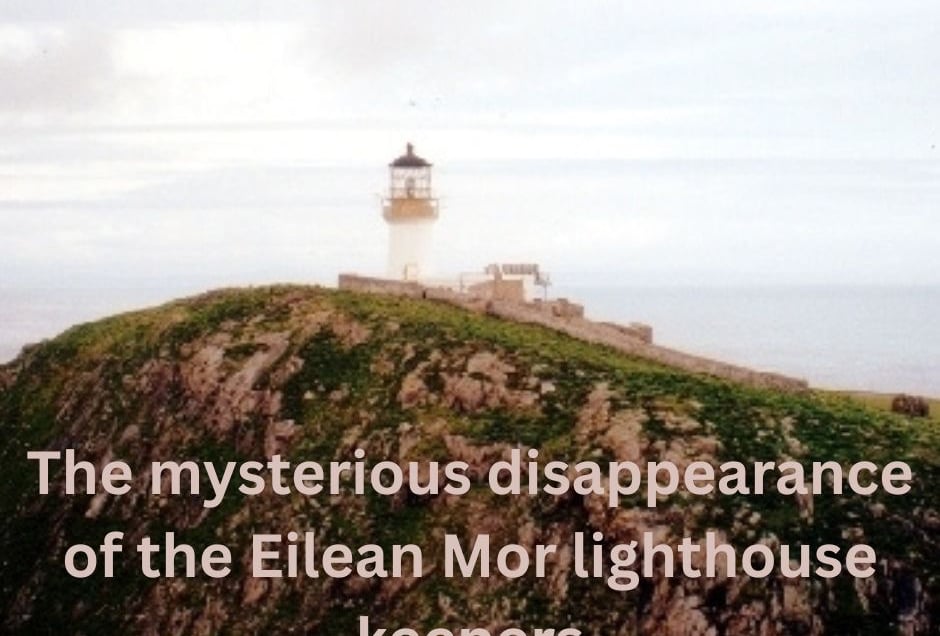
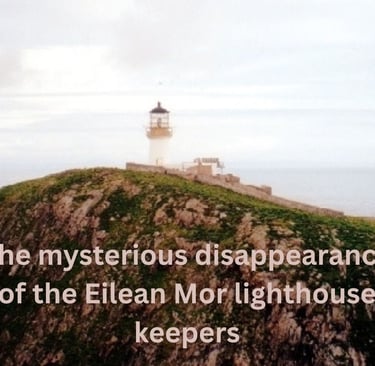
As the lighthouse tender the Hesperus slid up to the landing of Eilean Mor, the largest of the Flannan Isles, the crew noticed the lighthouse flag had not been raised like it usually was when the relief boat came. The captain of the Hesperus, James Harvey,sounded his horn and sent up a flare, but no one came to meet them.
Joseph Moore, the relieving keeper, climbed ashore to discover the three men had vanished without a trace. More than 125 years later, the mysterious disappearance of the Eilean Mor lighthouse keepers still fascinates us. Were they swept out to sea by a freakishly large wave? Did one of them murder the other two then himself? Or was there a more supernatural explanation for their disappearance?
The Eilean Mor lighthouse
The lighthouse at Eilean Mor had only become operational a year earlier on 7 December 1899. Four experienced lighthouse keepers were drafted from elsewhere in Scotland to run this new Hebridean lighthouse:
● James Ducat, principal lighthouse keeper
● Thomas Marshall, assistant lighthouse keeper
● William Ross, assistant lighthouse keeper
● Joseph Moore, assistant lighthouse keeper
Every lighthouse also had an occasional lighthouse keeper, who could cover in case of illness or injury. Eilean Mor’s occasional lighthouse keeper was Donald MacArthur.
The four keepers would rotate with each other, so there were always three keepers at the lighthouse and one on leave on the shore at Breasclete. Every two weeks, the keeper on leave would return to the lighthouse and relieve the next person in the shift pattern. They would then work six weeks before going on leave again. This was how it was supposed to work, but bad weather could delay relief keepers reaching the remote Flannan Isles.
Discovery of the missing lighthouse keepers
In early December 1900, it was Joseph Moore’s turn for leave. He’d spent his two weeks in Breasclete and had been due to return to Eilean Mor just before Christmas, but the bad weather had delayed the relief boat, the Hesperus. On 26 December, the weather cleared, and the Hesperus picked up Joseph Moore before heading to the remote island. As they neared the east landing, something seemed amiss.
The lighthouse keepers on duty would usually raise the lighthouse’s flag and come to meet them as they docked. But the flag was down, and there was no sign of Ducat, Marshall or Macarthur. Captain Harvey sounded his horn. There was no response.
Moore and some of the Hesperus’ crew rowed up to the island, and Moore went ashore to investigate. The kitchen was tidy, but Moore noted that the fireplace had not been used for several days. The beds were all made. There was nothing obvious to suggest that there was anything wrong, except the absence of the keepers and some damage to the iron railings at the west landing. The rule was that one person must remain in the lighthouse at all times, so all three being absent suggested there had been a major emergency.
Ó Photo by Patrick Tubby, posted on Lighthouse Accommodation (used with permission).
Moore returned to the rowing boat for help. He and the crew searched the rest of the island. On the west landing, ropes lay strewn around, and some of the equipment appeared to have been washed away. They all returned to the Hesperus and told Captain Harvey what they had found. He sent Moore and a couple of men back to the island to keep the light going while he returned to Loch Roag to alert the Northern Lighthouse Board (NLB).
The Secretary of the NLB received Harvey’s telegram at 8.27pm. This was the first indication the Board had that there was anything wrong at Eilean Mor. Now, they scrambled to find out what happened and to staff the lighthouse to tend the light. NLB Superintendent Muirhead arrived on Eilean Mor on 29 December with replacement lightkeeper Milne and storesman Jack.
Early indications suggested that the men had fallen from the cliffs at the west landing and had been swept out to sea. This is the suggestion Harvey had made when he telegraphed Muirhead about the disappearance. He siad:
‘A dreadful accident has happened at the Flannans. The three keepers, Ducat, Marshall and the Occasional have disappeared from the Island…The clocks were stopped and other signs indicated that the accident must have happened about a week ago. Poor fellows they must have been blown over the cliffs or drowned trying to secure the crane’.
Superintendent conducted his own investigation and came to a similar conclusion to Joseph Moore: the lighthouse keepers had been swept to sea by a freak wave.
When did the lighthouse keepers disappear?
But Muirhead still had to work out when the men had disappeared. The last time the light from the lighthouse had definitely been seen was 7 December. The NLB paid Roderick Mackenzie, a farmer on the mainland, to look out for signals from the lighthouse and report them to HQ. There was no telegraph on Eilean Mor, so the lighthouse keepers would send signals with the light if there was an issue.
He had last seen the light on 7 December. He didn’t worry initially – he assumed he couldn’t see it because of the bad weather – but, when he hadn’t seen the light by the lead up to Christmas, he asked his sons to help him watch for signals. His testimony puts their disappearance between 7 December and 28 December.
But we can narrow this down to between 7 December and 15 December. The SS Archtor was on its way to Leith from the United States and passed by the Flannan Isles on the night of 15 December. Captain Holman did not see the light from Eilean Mor. The weather was rough, but Holman was adamant he would have seen the light if it had been on. The lighthouse keepers must have disappeared by the night of 15 December.
This date is corroborated by information found in the station’s logbook. The principal light keeper, or an assistant light keeper in the principal’s absence, would log important information about the weather and lighthouse operations on a slate before transferring them into the official logbook at a later date.
The logbook entries stopped on 13 December, with 14 December and the first half of 15 December on the slate. From this information, Superintendent Muirhead assumed the Flannan Isles Lighthouse Keepers disappeared on the afternoon or early evening of Saturday 15 December.
Theories
Many theories have sprung up in the century that has passed that have tried to explain the disappearance of James Ducat, Thomas Marshall and Donald Macarthur. Below are just a few.
Some theories we can dismiss right away
Sea monsters
While Scotland is well-known for its mythical aquatic creatures, there is no solid scientific evidence of their existence. And I am reluctant to blame three deaths on something that probably doesn’t exist.
Sea gulls ate the men
Seagulls in Scotland are particularly vicious creatures. They will nose-dive for a poke of chips or an unguarded ice cream cone, but I’ve yet to hear of them eating their unsuspecting victims.
Pirates discarded their bodies in the sea
The North Atlantic is not a favourite haunt of pirates. Communities along the west coast of Scotland tended to be poor and have little of value to offer raiding pirates. There was also never any request for a ransom for the men.
Aliens abducted them
Need I say more?
Supernatural
The Western Isles have a long history of folklore and superstitions, and the Flannan Isles were no exception. Soon after the keepers had disappeared, rumours about a supernatural aboriginal people who lived on the islands west of Lewis began to swirl. This story could come from the Scottish kelpie tradition. One type of Kelpie was called the Blue Men of Minch who looked after sailors to drown and boats in distress to sink.
Eilean Mor was said to have been a holy sanctuary. The islands themselves were named after St Flannán, an Irish saint who reputedly used the Flannan Islands as a retreat for himself and his monks in the seventh century. A small chapel had been built on Eilean Mor in dedication to St Flannán and was rumoured to be involved in pagan sacrifices that were still allegedly being carried out in remote parts of the Hebrides at the time of the murders. These victims were said to be protected by the Sky Folk who took revenge on the keepers for transgressing the sanctity of the island.
By 1900, it had long been rumoured that the Flannan Isles were cursed, and they certainly appeared to be so. The lighthouse also appeared to be cursed. There was a series of mysterious events connected to the Flannan Isles:
● A man died during the construction of the Eilean Mor lighthouse.
● Just over a year later, the three lighthouse keepers disappeared.
● William Ross, who was supposed to be on Eilean Mor in December 1900, died suddenly on 15 April 1902.
● John McLachlan, one of the replacement lighthouse keepers, fell from a cliff on Eilean Mor and died on 20 August 1904.
● The Archtor, who passed Eilean Mor on the night of 15 to 16 December, struck the Carpie Rock 48 hours after passing Eilean Mor and then disappeared without a trace on or about 4 January 1912.
Naturally, there is no evidence that supports any theories about the Blue Men of Minch, the sky folk or any other supernatural being having murdered the three lighthouse keepers.
Murder–suicide
Unsurprisingly, rumours began to circulate that two of the men met foul play at the hands of the third. The theory is that one man lost his temper and murdered the other two before committing suicide. Some people may think that this scenario is unlikely, but there were instances of lighthouse keepers having breakdowns while on duty.
Donald John Macleod worked as an occasional lighthouse keeper from the 1930s. During World War 2, he was posted to Eilean Mor, and, while he was there, one of the keepers became violent and had to be restrained. Macleod believed that this could explain what happened on Eilean Mor in December 1900.
The keeper who is usually accused of the murder is Donald MacArthur. He apparently had a poor reputation and a bad temper. But this accusation only seems to have appeared long after the men disappeared. Any history of violence or disreputable behaviour would have surfaced after the men disappeared, and it’s unlikely the NLB would have hired a man with a violent temper for a job that could test the wits of the most solid man.
It’s certainly possible that tensions built up, and there was an argument, but there is no evidence that a violent struggle had broken out. If a fight had broken out in the kitchen, surely the furniture would be disarranged or broken and there would be blood somewhere. But the kitchen was clean and tidy. And it wouldn’t make sense for a man suffering from a mental breakdown that had just committed murder to tidy up after himself. If he did, it would show some premeditation and, then the question arises: what was the motive?
A sub theory is that the men were suffering from ergot poisoning. Ergot is a toxic fungus that grows on grain and can cause hallucinations and extremely irrational behaviour. The relief tender for Eilean Mor had been delayed because of the storms, so some suggest their bread had gone mouldy and poisoned one or all of the keepers to the point of insanity, at which point the above happened. The problem with this theory is that the logbook and slate suggest that the men were working normally until they disappeared.
The murder–suicide theory is not completely impossible, but there’s just no evidence to support it.
A giant rogue wave
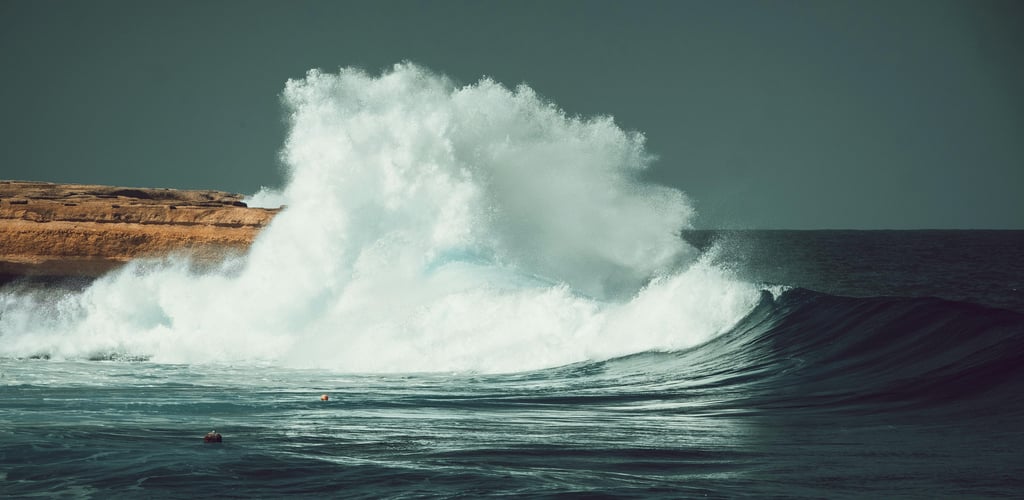
Superintendent Muirhead’s theory was that the men were on or near the cliff edge when they were blown into the sea. This seems the most likely scenario, but even this theory has its flaws. For instance, the severe winds were south-westerly that afternoon, so the men would have been blown back towards the island rather than out to sea. Muirhead also considered whether a giant wave could have swept them out to see.
The giant wave theory may sound ridiculous at first, given the height of the cliff, but subsequent lighthouse keepers at the Flannan Isles experienced freak waves. Jack Ross and his colleagues were almost swept out to sea by a giant wave while they were stationed on Eilean Mor. He believes that, had they not managed to cling onto the railings, they would have suffered the same fate as Ducat, Marshall and MacArthur.
Ó Photo by Ludvig Hedenborg: https://www.pexels.com/photo/waves-crashing-on-brown-rock-formation-7872073/
Niall Beag, who was stationed on Eilean Mor during the lighthouse’s construction, believed that a phenomenon called Muir Cul could explain the sudden disappearances. Changes to the wind direction could cause giant waves to form without warning. A seaman, Iain Angus, agreed that Muir Culs did form around the Flannan Isles, but he doesn’t think that one could have formed without it being felt or noticed elsewhere in the Hebrides.
It seems entirely possible that a large rogue wave swept the three men out to sea. But this theory doesn’t explain why all three were out on the cliffs at the same time when the rule was that one remained in the lighthouse at all times or why MacArthur was out in miserable weather in just his shirt.
What I think happened
The theory I lean towards is not too dissimilar to the giant wave theory.
The day started as every other day started. Marshall woke up Ducat just before 6am to start his shift. They had breakfast, Marshall went back to sleep, and others went about maintenance and cleaning.
At 1pm, they sat down to lunch. Perhaps Ducat took this time to update the slate with that morning’s information. The wind was picking up at this stage; by 2pm, it would be Gale Force 8.
They were probably worried about the equipment on the west landing, and Ducat and Marshall decided to go down to the landing to see what they could secure. It might seem strange that two experienced lighthouse keepers would take such a risk, but, 8 months before, Ducat and Marshall had been reprimanded for damage to that very landing caused by a storm. Wanting to avoid another telling off, they decided to see what they could do.
They put on their oilskin coats and traipsed down to the landing. They must have been reassured that the wind was in their faces rather than at their backs.
They may have gone down to the crane on the platform about half way down the cliff where there was a box of loose ropes. At some point, one of them slipped and fell either further down the cliff or into the sea. The other, realising he would not be able to help on his own, ran back to the lighthouse to fetch MacArthur.
This would explain why MacArthur left in just his shirt and why there was an overturned chair (if indeed there was an overturned chair): because time was of the essence to rescue the keeper in the sea. While the two men were trying to rescue the third, they were all swept out to sea by a wave or otherwise.
This theory isn’t exciting or glamorous, but it does answer most, if not all, the questions that are raised by the scene Joseph Moore found when he arrived on Eilean Mor on 26 December.
Conclusion
It is not surprising that people look for more supernatural explanations, given the mythology of the area. But very often, the simplest solution is the correct one. The men fell from the cliffs and were swept out to sea.
We may never know for certain what exactly happened to the Eilean Mor lighthouse keepers, but we can assume that the answer lies in natural rather than supernatural causes. For now, the solution to the mystery of the Eilean Mor lighthouse keepers remains out of our grasp.